
This image is used in good faith for educational and non-commercial purposes. We are committed to respecting the rights of creators and will take immediate action to address any concerns regarding this image. If you are the rightful owner of this image or know who is, please contact us here. We will promptly provide proper attribution or remove the image upon request.
String Quartet
Concours international de quatuor à cordes de la ville de Liège
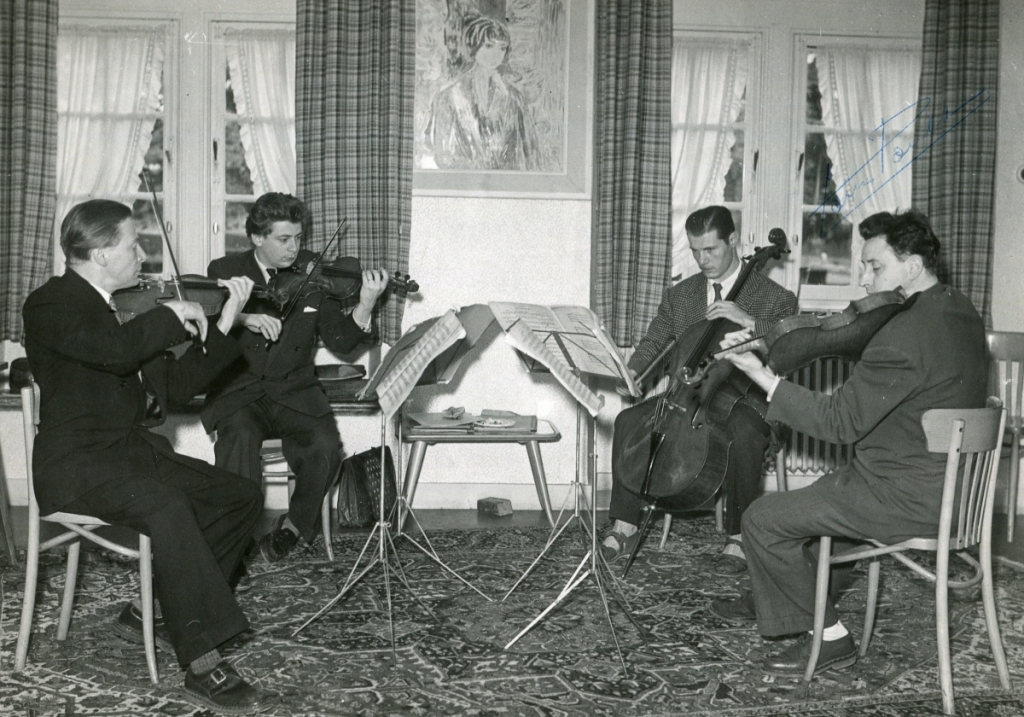
The Quatuor Municipal de Liège, originally established in 1925 as the Quatuor de Liège, was founded by the prominent composer and violist Jean Rogister. The ensemble quickly gained international recognition and toured extensively throughout Europe, performing in major cities such as Paris, Berlin, Vienna, Prague, Warsaw, London, Amsterdam, and Rome. The original members included Henri Koch (first violin), Gaston Radermaecker (later replaced by Joseph Beck in 1926 as second violin), Jean Rogister (viola), and his wife Lydie Rogister-Schor (cello). All members were alumni of the Conservatoire Royal de Liège.
The quartet’s exceptional artistry was a result of rigorous practice, with daily rehearsals of three to four hours, ensuring a perfect blend of their individual talents into a unified musical expression. This dedication led to glowing reviews and widespread acclaim, including performances at the Royal Palace of Laeken, where they were invited by Queen Elisabeth of Belgium.
Their repertoire was extensive, encompassing works from all major periods of classical music, including complete cycles of quartets by Haydn, Mozart, and Beethoven, as well as compositions by Schumann, Grieg, Borodin, Glazunov, Tchaikovsky, Debussy, and Ravel. They also championed Belgian composers such as César Franck, Joseph Jongen, and François Rasse. The quartet was responsible for premiering works by prominent composers like Béla Bartók, Guy Ropartz, and Arnold Bax, among others.
The Quatuor de Liège embarked on several successful tours in the United States, performing in prestigious venues like Carnegie Hall and playing for significant audiences, including the presence of Mrs. Herbert Hoover, the wife of the U.S. President. Despite the challenging conditions of travel during the 1930s, their performances were met with critical acclaim, cementing their reputation as one of the finest string quartets of their time.
After World War II, the ensemble did not reform, as its members pursued new paths, and Jean Rogister focused on composition. However, the Quatuor Municipal de Liège continued the legacy, featuring Henri Koch (first violin), his son Emmanuel Koch (second violin), Louis Poulet (viola), and Éric Feldbush (cello). They played a crucial role in interpreting and premiering numerous compositions, often under the patronage of Queen Elisabeth of Belgium, who regularly attended their performances.
The quartet was involved in prestigious competitions, where they were tasked with interpreting a vast array of new compositions and playing on different instruments for lutherie contests. The ensemble’s participation brought them into contact with some of the most notable musical figures of the time, including Luigi Dallapiccola, Frank Martin, and Jean Sibelius.
Despite the eventual dissolution of the original ensemble, the Quatuor Municipal de Liège remains a significant chapter in the history of Belgian chamber music, remembered for its exceptional contributions to both performance and musical education.
Source: Wallonica.org
# |
|||||||||
|---|---|---|---|---|---|---|---|---|---|
1 |
September 12, 1962 |
Conservatoire royal de Liège |
Liège |
Belgium |
Concours international de quatuor à cordes de la ville de Liège - International String Quartet Competition of the city of Liège |
Concours international de quatuor à cordes de la ville de Liège - International String Quartet Competition of the city of Liège |
Henri Koch (violin I), Emmanuel Koch (violin II), Paul Lambert (viola), Joseph Wagener (cello) |
Quatuor Municipal de Liège |
String Quartet No. 3 |
# |
Work Page |
|||||||
|---|---|---|---|---|---|---|---|---|
1 |
 |
YSC49 |
String Quartet No. 3 |
15 |
String Quartet (Violin I, Violin II, Viola, and Cello) |